
Can you really make pores look smaller in a week? Used consistently, yes. Clay doesn’t change the actual size of your pores — nothing does — but it draws out the oil and debris that make them look larger, and most people see a visible difference within about a week of daily spot-treating.
That’s the science. For me, this ritual is personal. I grew up in Iceland, where hot springs and lagoons are simply part of life. As a child, I’d play in the clay and silica along the edges while I watched the women around me care for their skin with what the earth gave them — no bottles, no labels, just what was there. I didn’t know it yet, but that’s where Root Science began. Even now, thousands of miles and a lot of years away, it’s still how I treat my own skin — pores included.
8 Amazing Clay Mask Skin Benefits
1. Clay Masks Unclog Pores Instantly
Clay masks unclog pores by drawing out excess oil, dead skin, and debris — the buildup that makes pores look larger and can lead to breakouts. As the mask dries, you’ll see dark spots forming on its surface, a sign it’s pulling impurities out of your pores in real time.
2. Clay Masks Improve Skin Texture
Clay improves skin texture by absorbing excess oil, impurities, and dead skin from the surface — revealing softer, smoother skin underneath. It also gently exfoliates, making it a good fit even for sensitive skin.
3. Clay Masks Neutralize Damaging Free Radicals
Clay neutralizes free radicals — unstable, positively charged molecules linked to visible signs of aging — because it carries a negative ionic charge when hydrated, allowing it to bind to and draw them out.
4. Clay Masks Help Acne
Clay helps with acne by binding to the dirt, debris, and bacteria that can worsen blemishes — without the harsh side effects some acne treatments carry. Because it also decongests clogged pores, consistent use can visibly reduce the size and frequency of breakouts.
5. Clay Masks Improves Skin Tone
Clay improves the look of skin tone by gently exfoliating away surface build-up, which reveals a more even, brighter complexion with consistent use. Removing dead skin and debris improves how your skin reflects light — the reason skin looks brighter and more even after masking.
6. Clay Masks Absorb Excess Oil
Clay absorbs excess oil the way a sponge does, pulling away the shine and impurities that build up when your sebaceous glands become overactive — whether from stress, hormonal changes, or hot weather — without relying on the drying ingredients found in some oil-control products.
7. Clay Masks Gently Cleanse
Clay cleanses just as effectively as a traditional face wash, removing impurities, bacteria, dead skin, and excess oil — without disrupting your skin’s natural balance. And you don’t need a foaming cleanser to feel clean: foaming agents can strip the skin’s natural oils and lead to irritation, especially with daily use.
8. Clay Masks Support Skin Barrier Health
Clay supports skin barrier health by cleansing, decongesting, and exfoliating without disrupting the skin’s protective barrier or its delicate microbiome — the way some acid exfoliants and harsh cleansers can. A compromised barrier often shows up as irritation, sensitivity, or imbalance, which is why gentler options matter for long-term skin health.
Not All Clay Masks Are Created Equal
The type of clay mask you use makes all the difference to your skin. When we talk about clay mask skin benefits, we’re talking about fresh, powder mask formulas (also known as anhydrous formulas) that are free from synthetics and harsh preservatives that can disrupt your skin’s microbiome.
A quick google search will give you thousands of clay mask options. But most of these are clay masks formulated with water, preservatives, binding agents, emulsifiers, synthetic fragrance and ingredients that can do more harm than good to your skin.
Regardless of there being a preservative present, pre-hydrated masks are highly susceptible to bacteria and mold contamination. Every time you dip your finger into that jar, your shelf-life dramatically decreases and the chance of that preservative working decreases with each contact. And preservatives are not directly beneficial to your skin, so if you can avoid them, you should.
If you’ve found yourself wanting to put fewer synthetic ingredients on your skin, that instinct makes sense. You don’t have to overhaul your entire routine to start — something as simple as choosing a fresh, powder-based mask over a pre-hydrated one loaded with preservatives and fillers is a meaningful place to begin.
So why not eliminate the risk for contamination and the need for preservatives entirely by eliminating the water component of the mask. Well that’s exactly what we do at Root Science! Giving you the power to activate your mask exactly when you need it, ensuring each treatment is equally as fresh as it is effective. You can even customize your treatment to your individual needs, as we will discuss in detail later on.
Now we know many of you may be thinking, “I don’t have time to mask”. Well, if you make time for Netflix or a book, then you have time to mask!
Keeping skin clear and healthy takes dedication and effort, something that should be viewed as a joyful ritual rather than a chore. Healthy skin requires you to do the work, inside and out. Much like exercise, consistency is key in maintaining your best skin.
How Do Clay Masks Work?
One of the most gratifying aspects of using a clay mask is that you can see and feel the results immediately. And with prolonged use, results only get better, ensuring your pore size appearance is minimized and breakouts decrease in frequency and size. Additional clay mask skin benefits include improvements in skin tone, texture, and an overall healthy glow.
Organic. Phytoactive. Skin Nourishment.
Looking To Treat Your Skin To A Clay Powered Facial Mask?
Best Types of Clay For Skin
While there are many varieties of clay, we’ve narrowed it down to the most powerful clays for effectively treating and improving the delicate skin on your face.
French Green Clay
As the name indicates, French green clay comes to us from France and gets its green color from decomposed plant matter, also known as phytonutrients. This is one of the best clays for blemish-prone skin due to having one of the highest absorption capacities, effectively deep cleaning and decongesting clogged pores.
Bentonite Clay
Known as the healing clay, bentonite clay is prized for its benefits, internally and externally. Our bentonite clay is sourced from the United States and is composed of naturally occurring volcanic ash. Bentonite is a rich source of minerals such as silica, magnesium, sodium, copper, iron and potassium. It has been studied for its effect on promoting the appearance of firmness, attributed to its high silica content. Bentonite clay is also valued for its soothing benefits.
Kaolin Clay
Kaolin clay is one of the mildest and most gentle clays, making it ideal for sensitive and reactive skin. Regardless of its gentle nature, Kaolin clay is still highly beneficial to the skin and effectively cleanses and exfoliates without the use of synthetic surfactants and abrasives.
Rhassoul Clay
This skin softening clay comes to us from deep within the Atlas Mountains of Morocco. It’s recommended for dry and mature skin in need of rejuvenation. Rhassoul clay has been used as a body, face and hair treatment for over 1400 years and is a staple ingredient in luxury spa treatments. Rhassoul clay is known for improving the appearance of skin tone, texture and promoting a healthy glow.
When To Apply A Clay Mask
– Mask 15 minutes before a shower or bath.
– Mask while reading a book.
– Mask during a movie or your favorite sitcom.
– Mask during your at-home yoga/workout session.
How To Use A Clay Mask
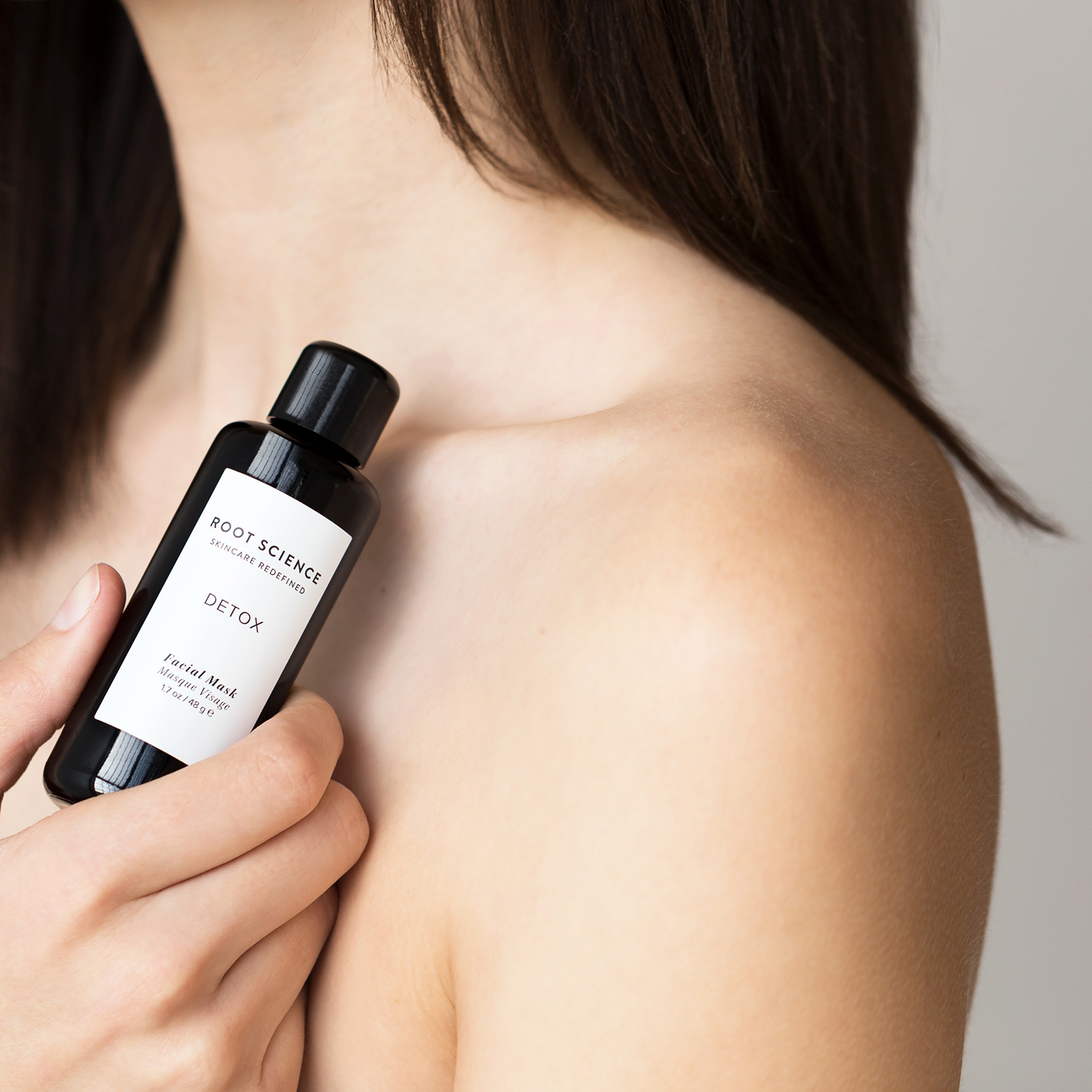
Begin by transforming your fresh powder mask into a creamy paste by mixing it with a liquid of choice. Our powder masks are housed in a very special violet glass that preserves the clays and fresh herbs. By keeping our masks in powder form, it allows us to avoid the use of fillers and harsh preservatives. Mixing your own mask is worth the extra skin benefits.
The most basic way to activate your mask is by mixing it with hot water. We recommend using hot water as it will activate the herbs, very much like steeping a tea. Always begin by adding a small amount of liquid, a quarter teaspoon or less at a time, mixing and adding more until the perfect consistency is achieved — a creamy, pudding-like texture.
Try to avoid making the mistake of adding too much water at first, as that will dilute the mask, and the only way to fix that situation is to add more powder to the mix. Allow the mask to steep for 1-2 minutes and test the temperature with your finger before applying.
How To Customize Your Clay Mask
One of the main benefits of using a powder mask, instead of one that comes pre-hydrated, is that it allows you to customize the treatment to your skin’s current needs. You control if the mask will be an extraction mask, moisture mask, exfoliating mask, or a little bit of everything.
Below are 4 ways to customize your Root Science mask depending on your skin’s needs. We recommend masking 1-3 times per week. You can use our masks as full facial treatments or simply spot treat areas of congestion and blemishes.
You will notice results almost immediately if this is your first-time masking, but know that a consistent routine of masking weekly will have the most profound effect on your complexion and improve your skin over time. We are proponents of the slow and steady approach when it comes to caring for your skin as it yields long term results and supports optimal skin health.
Your skin barrier is sensitive, so if you shock it with harsh treatments, you can throw your skin barrier function out of balance. Signs that indicate your skin is being stressed or imbalanced include excess oil production, rashes, bumps, redness and dry patches. These signs are your skin telling you “too much, too fast”. Slow and steady is the way to go, very much like exercise.
You’ll begin to notice a smoother, more even-toned complexion and less noticeable pores with consistent use. Pores themselves don’t change size — a 2023 clinical study on kaolin and bentonite clay masks found no significant change in pore area itself, even as sebum levels and skin texture improved significantly over four weeks. What clay does do is absorb the excess oil and debris that make pores look larger in the first place, which is why consistent use makes such a visible difference.
1. Add raw honey to create a skin softening enzyme mask.
2. Add plain yogurt to create a cooling + probiotic mask.
3. Add 1-2 pumps of facial oil to create a deep moisture-replenishing mask.
4. Add green tea instead of water for an extraction mask with astringent and antioxidant benefits.
For detailed recipes for customizing your clay mask, explore our Product Tips & Tricks page. Videos of how to apply our Detox and Reborn masks can be found here and here, respectively.
How To Properly Apply Clay Masks In 3 Easy Steps
Step 1:
We recommend starting with a bare face. You do not need to cleanse your face before applying a clay mask, unless you need to remove makeup and/or SPF. We do not recommend cleansing right before a mask to avoid disrupting the PH of your skin. If you need to wash your face to remove makeup and SPF, allow your skin a few minutes to recalibrate before applying the clay mask.
Step 2:
Apply a generous layer of a freshly-activated mask all over face and neck, avoiding areas that are fragile, such as the under-eye area, lips or any broken or chapped skin. Leave on for 15 minutes or until dry. Some people may think that by leaving the mask on longer that it will increase the benefits. However, this couldn’t be further from the truth. Do not leave the mask on for long once it has dried, as it can irritate the skin and negate some of the amazing clay mask skin benefits. Once the mask dries, remove it or rehydrate it, if you decide to leave it on longer. If you mix your mask with honey, oil or yogurt, you can leave the mask on longer, roughly 45 minutes.
Step 3:
We always recommend masking before a bath or shower for ease of cleanup. Remove the clay mask using warm water. Begin by splashing your face to rehydrate the mask and gently massage your skin for gentle exfoliation. Continue rinsing and massaging until mask is fully removed. Always follow with a moisturizer and/or nutrient-rich oil-based serum. It is vital to replenish moisture after using a clay mask.
Clay Masks: A Natural Blemish Spot Treatment
Clay replaces the need for harsh synthetic spot treatments. Simply apply a clay mask on blemishes as they begin to appear, to stop them in their tracks.
Clay Mask Frequently Asked Questions
Can clay masks actually shrink pores?
No — pore size itself doesn’t change. What clay does is absorb the oil and debris that make pores look larger, so they appear smaller once that buildup is cleared.
How often should you use a clay mask?
For general use, 1–3 times a week. If you’re dealing with visibly congested pores, spot-treat the T-zone daily for about a week, then scale back to 1–2 times a week for maintenance.
What’s the best clay for pores?
French green clay has one of the highest absorption capacities, making it well-suited for congested, blemish-prone skin. Bentonite offers deeper oil absorption for oilier skin types.
Are clay masks safe for sensitive skin?
Kaolin clay is the mildest option and is well-tolerated on sensitive and reactive skin, while still cleansing and gently exfoliating.
The Bottom Line
As you can see, clay mask skin benefits are numerous, which is why clay makes for such a powerful ingredient in skincare formulations. But at Root Science, we don’t stop there. Each of our clay-based facial masks is infused with organic, time-honored botanicals renowned for their skin beneficial properties and overall beautifying effects on the skin. We supercharge each formula, ultimately building upon the foundational powers of clay.
Shop Featured Products


Disclaimer: This content is for informational and educational purposes only. It is not intended to provide medical advice or to take the place of such advice or treatment from a personal physician. All readers/viewers of this content are advised to consult their doctors or qualified health professionals regarding specific health questions. Neither Root Science nor the publisher of this content takes responsibility for possible health consequences of any person or persons reading or following the information in this educational content. All viewers of this content, especially those taking prescription or over-the-counter medications, should consult their physicians before beginning any skincare, nutrition, supplement or lifestyle program. The views and products expressed are not intended to treat, cure or prevent any disease.
Sources: Zhang et al., “Comprehensive assessment of the efficacy and safety of a clay mask in oily and acne skin,” Skin Research and Technology, 2023.